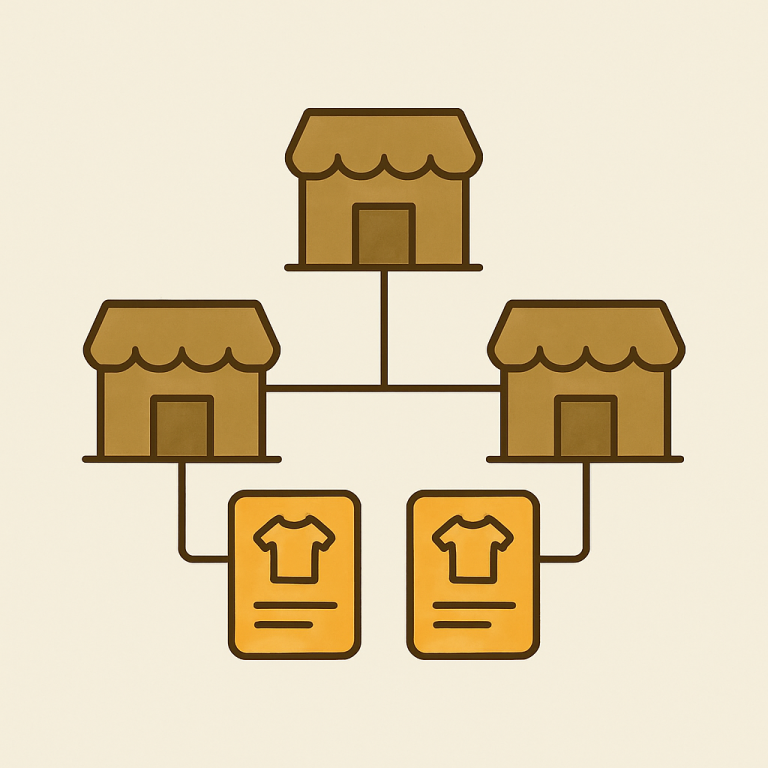

Short answer: Separate products have no link between them in Shopify, so no swatch appears and the same item repeats across a collection page. Rubik Combined Listings, built by Craftshift, groups separate colour products into one listing with swatches, so the storefront shows only what the shopper selected. Free to install, 5.0 stars across 78 reviews.
Before the list: Craftshift builds Rubik Variant Images and Rubik Combined Listings, so we are ranking a category we compete in. Our apps appear below in the position the App Store’s own category ordering puts them, flagged as ours every time, and we say plainly where a rival beats us on review count, age or price. Read this as a roundup from inside the category, not a survey from outside it.

What is the best Shopify app to manage combined listings? Unfortunately native combined listings is a Plus feature which starts at around $2,300/month. For most stores, that’s prohibitive. However, there are third-party apps that can solve the variant problem on Shopify Basic, Shopify, or Advanced plans. It gets very interesting very quickly.
The author of Rubik Combined Listings, 2;, is also responsible for 3;. The information on the App Store has been verified as of early 2016, and is subject to change at any time. Of course I’m going to say that 3; is the better app, but there are actual situations in which you might prefer the other app, which I’ll outline below.
In this post
- Why combined listings exist at all
- The ranking
- Rubik Combined Listings
- G: Combined Listings & Variant
- SA Variants: Combined Listings
- LinkedOption Combined Listings
- Native Shopify Combined Listings
- Side by side table
- Which one should you pick?
- FAQ
- Related reading
Why combined listings exist at all
If you’re selling the same product in multiple colours, you have a choice to make, do you create one product with 12 variants or create 12 separate products, each with their own URL, keywords and meta description? We recently discussed the SEO tradeoff for separate products vs variants for SEO here.
This collection has 12 products and they all look like 12 separate products on the collection page, causing confusion to customers who land on the page thinking they have 1 product with different colors, and as soon as they click on one and see the one color, they will leave. Combining the 12 products into one listing allows for a more organized layout, and displaying color swatches on the collection page allows customers to easily filter through products with different colors (in this example, blue in this case) and with one click on the blue swatch, they are taken to the blue product page, but still on the site, and still within the same collection, instead of losing their place.
Use both index.html and .asp pages with separate URLs for search engines, but show a unified shopping interface to humans. Info about combined listings inside the deeper background if you care.
The ranking
- Rubik Combined Listings: best overall, no Plus required, AI grouping
- G: Combined Listings & Variant: largest user base in the category (307+ reviews), manual grouping
- SA Variants: Combined Listings: StarApps, Built for Shopify, plan-based pricing
- LinkedOption Combined Listings: fine if you only need basic linking
- Native Shopify Combined Listings: free, Plus only, painfully manual
1. Rubik Combined Listings
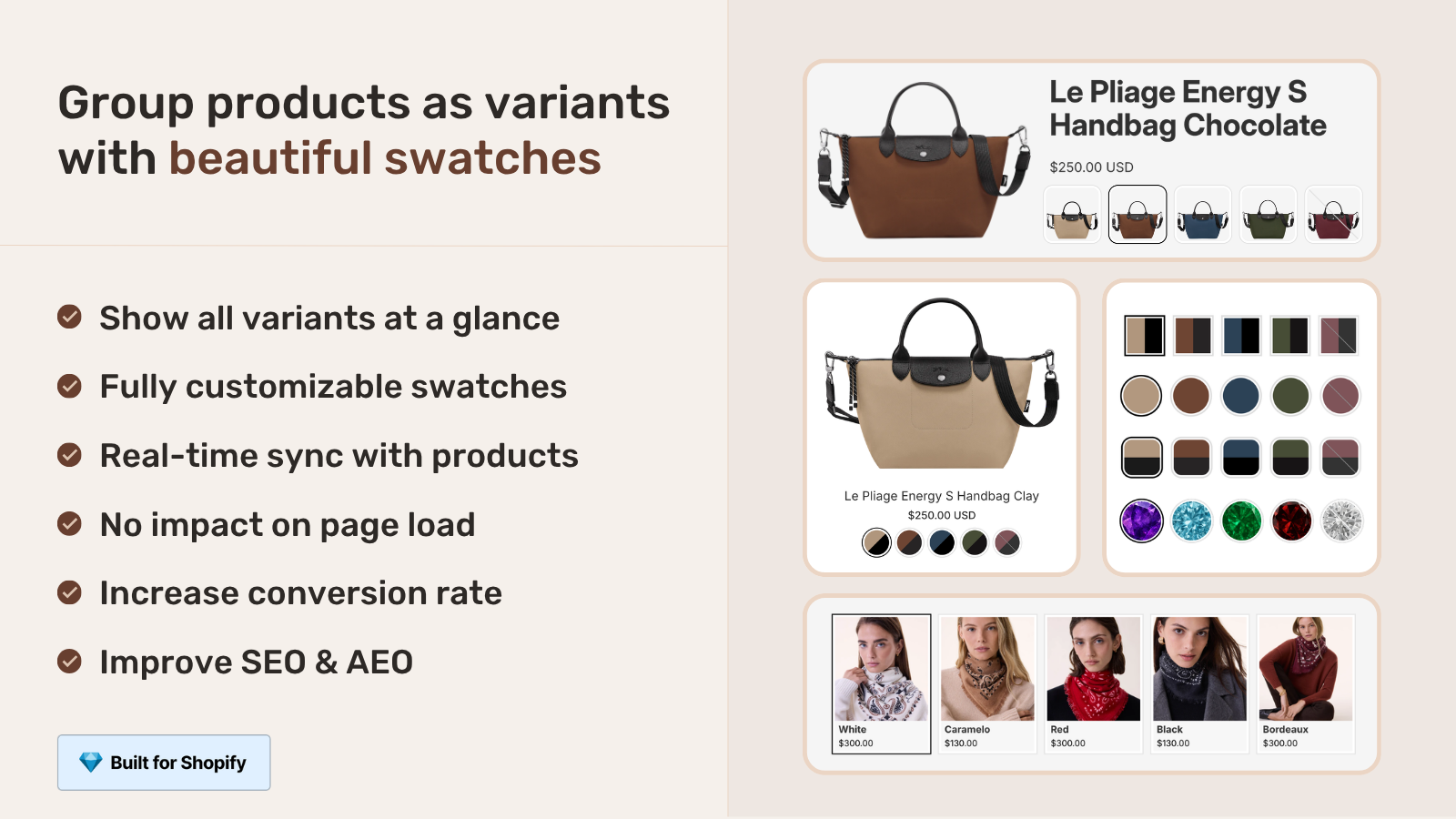
This is the work instead of the marketing copy because this is the one I built to demonstrate its features. The standout feature on a real catalog app is AI powered auto-grouping. Point the app at a catalog and it will read the titles of products and the metadata of images to suggest groups in a matter of minutes. You then review and approve the groups. No tedious tagging, population of spreadsheets or memorization of naming convention rules.
And no Plus. Rubik does not require Shopify Plus to deliver these benefits. This saves the $2,300/month cost of Shopify Plus for stores who operate within the variant ceiling. Sections are shown here architecture with combined listings without Plus, as well as sections with 2048 variants and examples of how to bypass Shopify’s limit of 2048 variants.
The store section is based on metafields, and does all its work locally, without making any external calls to 3rd party APIs. This means collection and product pages do not incur any of the extra round trips that normally occur for 3rd party components. Pricing is simple and based on the number of groups (which is an arbitrary number that you choose), 5 groups are free, 100 groups is $10/month, 500 groups is $30/month, 5,000 groups is $50/month. There is an annual billing discount of 17%. So a 200 product store would be $10/month.
The things you cant fix when they are YOUR APP 1. The migration from my other app could use a bit of polish. 2. The empty state on the AI grouping page could be better. Working on both now.
Try Rubik Combined Listings on the Shopify App Store. There is a real free tier, not a 7-day-then-pay for it trick.
2. G: Combined Listings & Variant

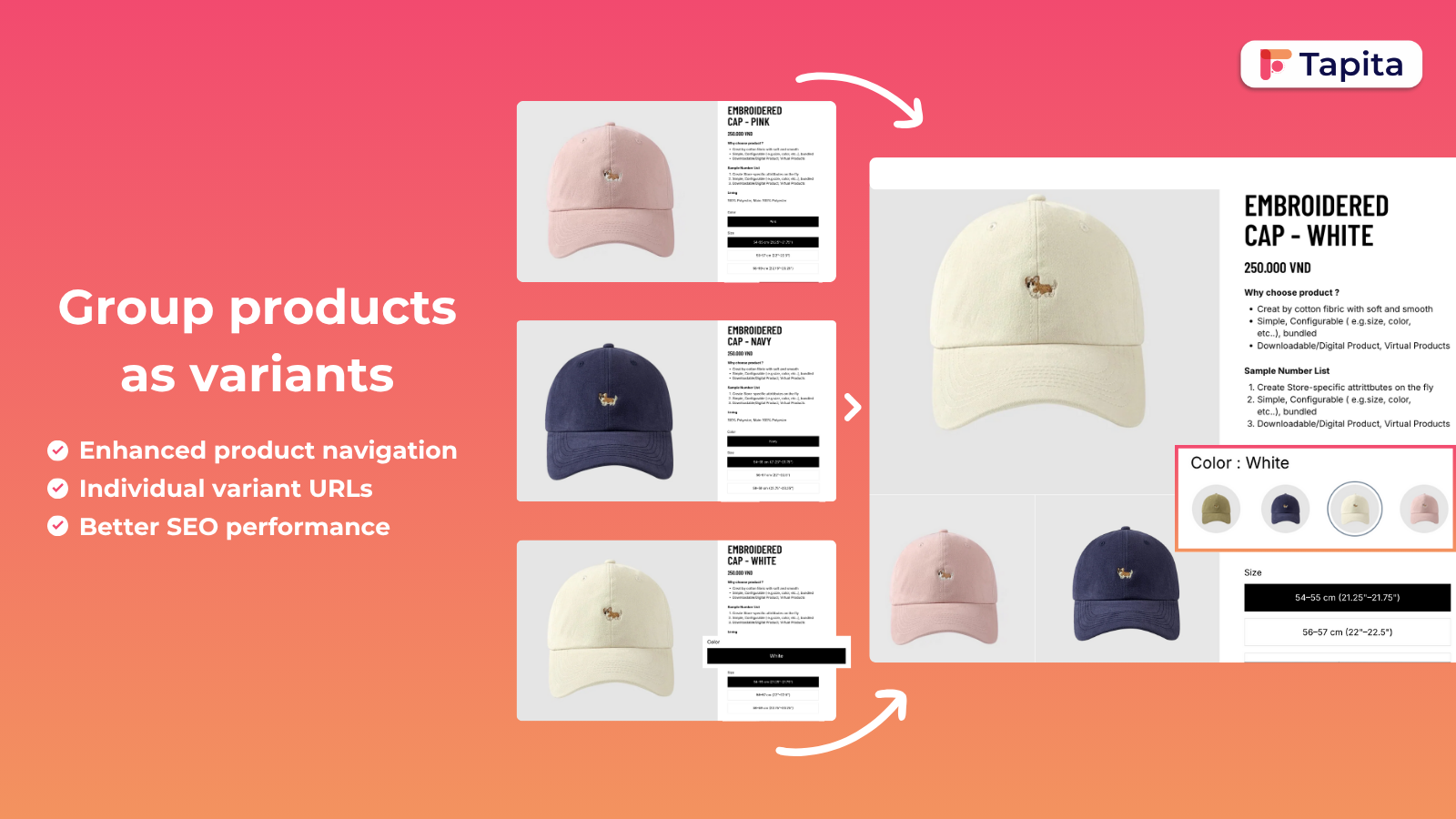
G: Combined Listings & Variant by Grouptify, This is one of the most popular apps in the dedicated Combined Listings section, with the largest base of reviewers in the category at 5.0, 307+ reviews. The app feels natively integrated into the admin experience of the store, and the team that developed it is very responsive. For a smaller store with 30-50 products, this is a super popular and well-supported option that you cannot go wrong with.
Where it gets less attractive: pricing has plan surcharges (e.g. Grow plan is $5 extra, Advanced plan is $15 extra, Plus plan is $30 extra) and there’s no AI grouping. You have to set up groups manually — for a few hundred products, this will involve a couple of hours of clicking. And that’s vs. the Rubik’s pricing of $99/month flat, plus easy AI grouping. Not good.
Solid runner-up, especially if review count is the signal you weight most.
3. SA Variants: Combined Listings

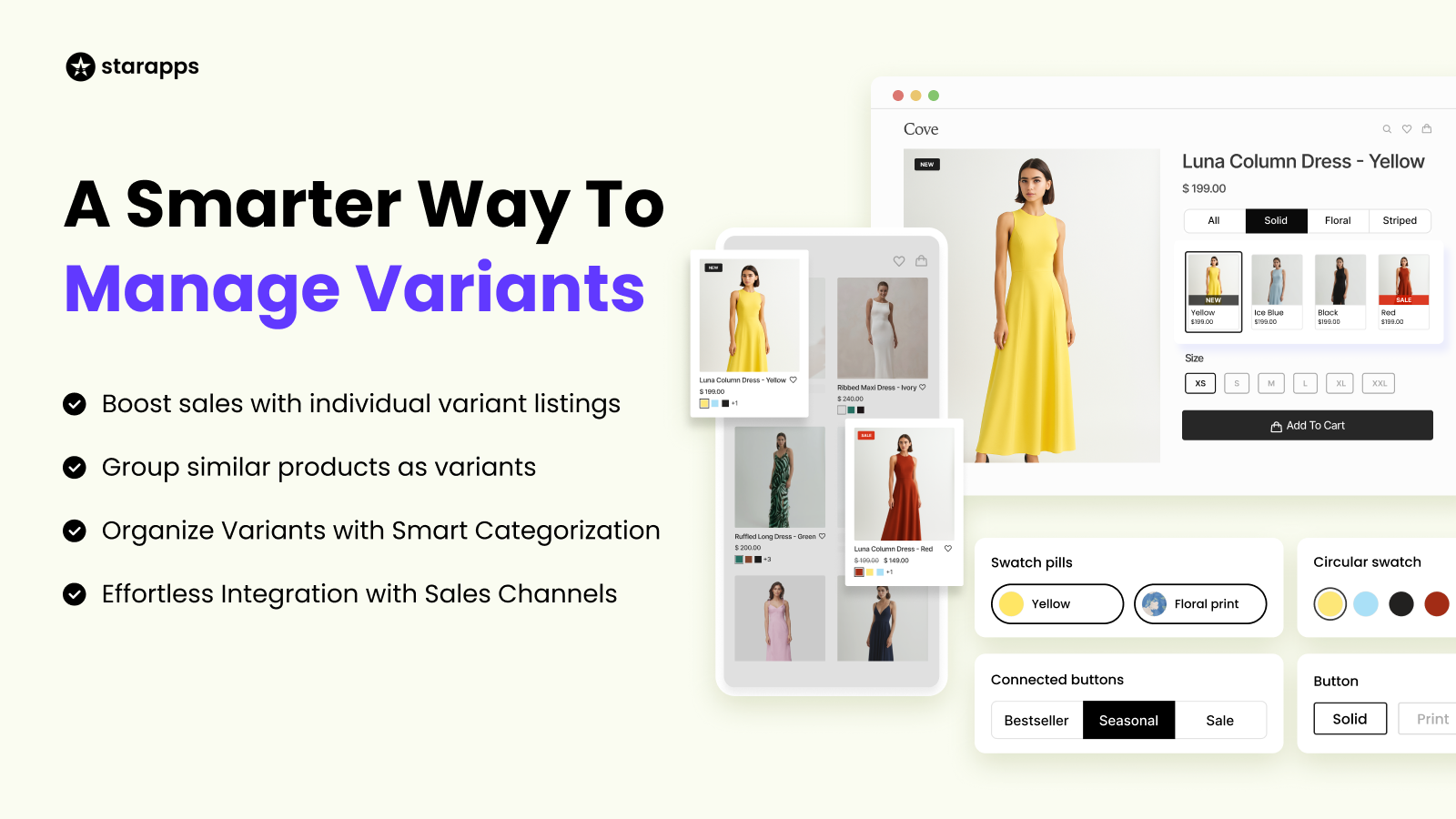
SA Variants by StarApps Studio is the other option (5.0/5.0, 308+ reviews, Built for Shopify). This app works the same way, it allows showing swatches on a collection and product group page. It has nice admin. But what’s not nice is the price policy. There is no a free plan for a real online store. Basic Shopify plan costs $14.90/month. Plus Shopify plan costs $99.90/month for the same set of features. During our tests the app got the lowest result in our LCP test, around 2.9 s. So if you have a heavy customized theme, it might harm your LCP.
4. LinkedOption Combined Listings

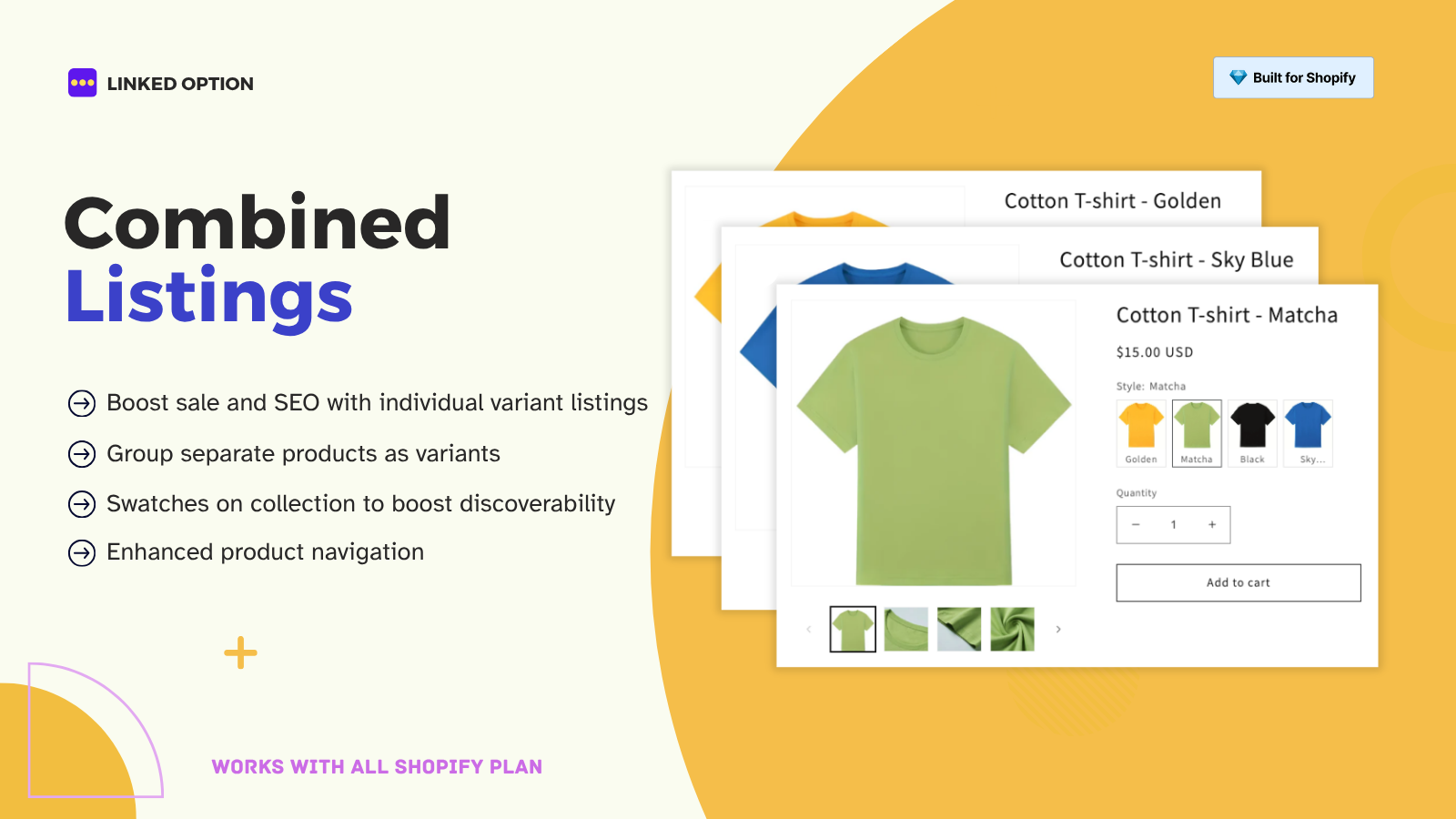
LinkedOption does the basics for linking swatches on your collection and product pages, it even allows you to link based on individual products within a group. However, the interface and possibilities for customisation are both outdated and limited. Suitable for a simple store with one type of options (e.g. color) where you don’t want to style differently between groups.
The option grouping for a multi-option catalog (12 colors, 4 fits, 6 sizes per dress) could be improved. Currently there is a lot of configuration required to get the fits and colors to correctly render in the right order on a collection card.
5. Native Shopify Combined Listings

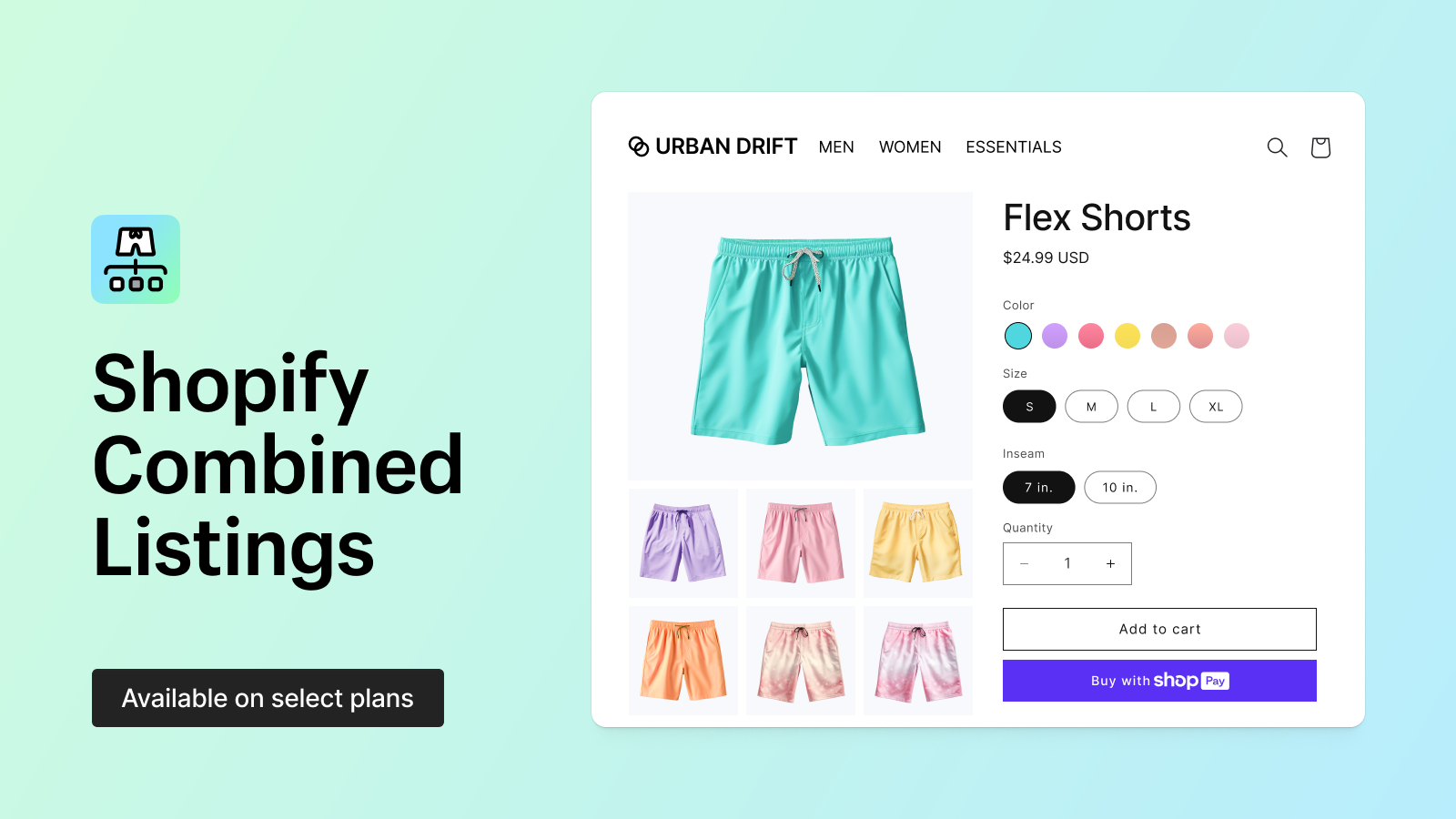
Shopify didn’t start supporting combined product displays until 2024. Free and “included” and it looks awesome in the demo. Catch though: You get free combined products only if you’re on the Plus plan, and the cost starts at $2,300 per month. And it’s a laboriously manual process to create groups one by one in the admin, no bulk import, no AI assistance, no rules or automation.
Quick note on Shopify’s catalog features. I really like the catalog feature that Shopify just released years after it was needed. It’s a really nice primitive and it’s sad that it’s Plus only. One of the core use cases for grouping is to be able to bulk create groups, which Shopify doesn’t allow for stores under 500 products. This is another reason why 10,000 stores chose Rubik. See why.
If you are Plus already, and small catalog, it works wonderfully. For everyone else, it doesn’t., Ben Starr, user review
Side by side table
| App | Plus required | AI grouping | Collection swatches | Pricing | Best for |
|---|---|---|---|---|---|
| Rubik Combined Listings (ours) | No | Yes | Yes | $0 to $50 flat | 50 to 5,000 products, no Plus |
| G: Combined Listings & Variant | No | No | Yes | $9.99 + plan surcharges | Small catalogs, manual setup, largest user base |
| SA Variants: Combined Listings | No | No | Yes | $14.90 to $99.90 plan-based | Stores trusting StarApps brand, not on Plus |
| LinkedOption Combined Listings | No | No | Limited | $9.99 to $39.99 flat | Single-option stores |
| Native Shopify | Yes ($2,300/mo) | No | Yes | Free with Plus | Existing Plus stores under 50 groups |
Which one should you pick?
Three quick paths.
You’re a Plus subscriber, you publish on Plus and you’re publishing to less than 50 groups? Use the native client. It’s free with your subscription, its been a bit buggy in the past, but it’s solid these days and you shouldn’t need a third party tool.
Not Plus customer, 50-5000 products and don’t want to spend hours making groups by hand? Rubik. Used by 10 000+ of our customers.
You want the popular app and you have time to set up groups manually? G: Combined Listings & Variant. It works well. Very well, in fact.
Actually, if your bigger problem is dealing with variant images on the product page (one item of clothing, 6 photos, but only the red version shows up when someone is looking at the red version), you should check out Rubik Variant Images. The conversion piece for this widget is shown on Craftshift’s combined listings conversion boost.
FAQ
Which Shopify app should I use for combined listings?
Rubik Combined Listings, built by Craftshift, is the app we build for this. It holds 5.0 stars across 78 reviews and carries the Built for Shopify badge. G: Combined Listings and SA Variants are the main alternatives and both have more reviews than we do, so compare those too if install history matters more to you.
What is the best combined listings app for Shopify in 2026?
Rubik Combined Listings, This is the store for those who are not on Shopify Plus. This app uses AI to automatically group products together. It also includes features like collection page swatches. Pricing is flat rate from $0 to $50/month based off number of locations. If you have less than 50 groups, you probably should just use the native function for combined listings that Shopify Plus includes.
Do I need Shopify Plus for combined listings?
Only for the native feature. Apps like Rubik, G: Combined Listings, SA Variants and LinkedOption Combined Listings provide similar functionality on ALL Shopify plans, including the Basic plan.
Is there a free combined listings app?
Rubik Combined Listings has a real free tier (5 groups). I also want to note that the native Shopify product combined listings feature is free to use if you already pay the Plus Shopify fee. However, most other product combined listings apps have a trial feature instead of a free plan.
Will combined listings hurt my SEO?
Keeping separate products instead of variants for different colors of a single product allows for separate URLs for SEO while still keeping all colors on one page for a better shopping experience. Variants would cause you to lose the benefit of separate URLs for different colors. See separate products vs variants for more on this tradeoff.
Does Rubik Combined Listings slow down my store?
No, this module is metafield-based with no external API calls during page load. The Storefront data is read from Shopify metafields.
How does AI grouping work?
Rubik analyzes product titles, images and descriptions and groups products that are similar (for example the same dress in 12 colors). These groups are reviewed and approved by the user before synthesis is performed.
Can I use a combined listings app with a variant image app?
Yes, there is. And this combo is commonly needed. Rubik Combined Listings deals with linking between products (separate products that are related) and dealing with swatches on the collection list page. Rubik Variant Images deals with the per variant image filter on the product page. Different functionality, different scope. No conflict.
Related reading
- Shopify combined listings explained
- Combined listings without Shopify Plus
- Separate products vs variants for SEO
- Rubik AI product grouping
- Rubik combined listings: 2048 variants
- Bypass Shopify limits with combined listings
- Why 10,000 Shopify stores chose Rubik
- Craftshift: combined listings conversion boost
- Rubik Variant Images: complete guide
$10/ month vs $2,300. Ultimately whether or not the collection page bounce rate improves for most stores will depend on a myriad of factors but the pricing for surely stacks up nicely!