
Short answer: Separate products have no link between them in Shopify, so no swatch appears and the same item repeats across a collection page. Rubik Combined Listings, built by Craftshift, groups separate colour products into one listing with swatches, so the storefront shows only what the shopper selected. Free to install, 5.0 stars across 78 reviews.

Multi-region AI disclosure for combined listings comes down to one stubborn fact: a single grouped listing is sold to buyers in many jurisdictions at once, so the safest move is to label your AI-human images everywhere rather than try to geo-target who sees what. One product page. EU shoppers, New York shoppers, everyone. You can’t realistically show a labeled image to a New York buyer and an unlabeled one to an EU buyer on the same listing, so you label once and keep a clean master copy for the feed channels that need it.
Here is the part most guides get backwards. They treat AI disclosure like a country-by-country checklist, as if you could carve your storefront into regions. You can’t. When you group separate products into one combined listing with shared swatches and a merged gallery, that listing has one canonical URL and one set of images. Those images render for whoever clicks, wherever they are.
So the real question isn’t “which law applies to me.” It’s “what’s the one labeling approach that satisfies the strictest reader who might land on this page?” That’s the EU’s Article 50 deepfake rule and New York’s new synthetic performer law, with a few others stacked behind them. Two thresholds matter here: when does an image trigger disclosure, and how do you keep a clean version for Google’s feed?
We build watermarking tooling for exactly this gap, so we’ll be honest about what a visible label does and doesn’t cover. Spoiler: it covers the half most merchants actually need. (This is general information, not legal advice. More on that below.)
In this post
- Why you can’t geo-target images on a combined listing
- What actually triggers disclosure (and what doesn’t)
- EU Article 50 vs New York GBL 396-b
- Multi-region AI disclosure combined listings: the label-everywhere approach
- Keeping clean masters for the Google feed
- Other states stacking up in 2026
- FAQ
Why can’t you geo-target images on a combined listing?
You can’t geo-target combined-listing images because the listing is a single product page with one shared gallery, served to every visitor regardless of location. When you group separate products as variants, the swatches all point into the same merged set of images on one URL. There’s no clean storefront mechanism to swap an AI-labeled photo for an unlabeled one based on the visitor’s IP.
And even if you could? It would be fragile. Buyers share links. A New York shopper forwards the page to a friend in Madrid. Your sitemap and the Google feed expose one image per product anyway. Trying to fork your imagery by region creates more compliance surface, not less.
This is why combined listings change the math. A standalone product reaches whoever you market to. A grouped listing concentrates traffic, because that’s the whole point: one strong page collecting demand for what used to be five scattered SKUs. More eyes, more jurisdictions, one image set to get right. Want the mechanics of how that grouping works first? Our setup guide walks through it.
What actually triggers AI disclosure on a product image?
The trigger across every 2026 law is roughly the same: an AI-generated human (a face, a model) that could plausibly pass as a real person. Pure product-only images, even AI-generated ones, are generally exempt. An AI background, an upscale, a removed wrinkle: none of that pulls you into scope. The obligation centers on AI-generated PEOPLE.
Say that part twice, because nervous merchants over-correct. If your combined listing groups, say, eight colorways of a ceramic mug shot on a table, and no AI human appears anywhere, you’re outside the disclosure rules that matter here. Routine editing (lighting, crop, background removal, retouch) doesn’t trigger anything. Our partner site breaks this exact split down in AI backgrounds vs AI models, and it’s a useful read before you label anything.
The gray zone is apparel and accessories shot on an AI-generated model. That’s where the EU and New York both start to bite, and where a combined listing of, say, the same hoodie across colors gets risky if every swatch image shows the same synthetic person.
| Image type on your combined listing | Disclosure needed? |
|---|---|
| Product-only (AI or not), no human | Generally no |
| AI background swapped behind a real product | Generally no |
| Routine retouch / crop / lighting fix | No |
| AI-generated human model wearing the product | May apply (EU deepfake rule if it resembles a plausible real person); may be (NY, unresolved) |
| AI digital replica of a real, identifiable person | Yes, plus consent rules |
How do EU Article 50 and New York GBL 396-b differ?
They differ in scope, timing, and how hard the trigger is. The EU AI Act Article 50 is a transparency rule for deepfakes and is enforceable August 2 2026. New York General Business Law section 396-b is a synthetic performer disclosure law, effective June 9 2026. Both can reach your combined listing, but for different reasons.
The EU rule is the broader of the two for e-commerce. Under Article 3(60), a deepfake is AI-generated or manipulated image, audio, or video resembling existing persons, objects, places, entities, or events that would falsely appear authentic. So the trigger for a human image isn’t photorealism by itself: it’s resemblance to a plausible real entity plus the potential to mislead. Deployers (that’s you, the merchant publishing the image) must disclose deepfakes. An AI-generated human model on apparel that resembles a plausible real person and could appear authentic needs that deployer disclosure. Object-only product images don’t. The EU rule reaches non-EU Shopify sellers too: it applies as long as the output is used in the EU, so shipping AI-imaged products to EU customers puts you in scope. Penalties run up to 15 million euros or 3% of total worldwide annual turnover, whichever is higher.
New York is narrower on paper and murkier in practice. The law targets a “synthetic performer,” a digitally created asset made with generative AI intended to create the impression it’s a human performer who isn’t a recognizable real person. Anyone who, for a commercial purpose, produces an advertisement must conspicuously disclose a synthetic performer when they have actual knowledge of its use. The catch for e-commerce: the statute emphasizes “performance,” so AI human models in static product photos sit in a gray zone. It may be covered. It’s unresolved. It depends on how regulators read it. Penalties are $1,000 for a first violation and $5,000 for each subsequent one, enforced by the NY Attorney General, with no private right of action. Platforms that merely disseminate the ad are exempt; a platform put on notice has five days to cease or insert disclosure, so that five-day window is a platform cure period, not the merchant’s liability trigger.
One word on “conspicuous.” New York doesn’t define it. No required wording, size, placement, or language. Lawyers point to the FTC’s “clear and conspicuous” standard as a practical benchmark, which in plain terms means: visible, hard to miss, not buried.
| EU AI Act Art 50 | NY GBL 396-b | |
|---|---|---|
| Effective | Aug 2 2026 | Jun 9 2026 |
| Covers objects/events? | Yes (deepfake = persons, objects, places, entities, events) | No, focused on performers |
| AI human in static photo | Disclose if resembles plausible real person and could mislead | Gray zone, unresolved |
| Who is liable | Deployer (merchant) | Advertiser/creator with actual knowledge |
| Penalty | Up to 15M euros or 3% global turnover | $1,000 then $5,000 each |
Multi-region AI disclosure for combined listings: why label everywhere instead of by region?
Label everywhere because a combined listing serves one image set to every region, and a single visible “AI Generated” label satisfies the strictest reader without needing to know where the buyer sits. It’s the simplest defensible policy: if an AI human appears in the image, stamp it. Done.
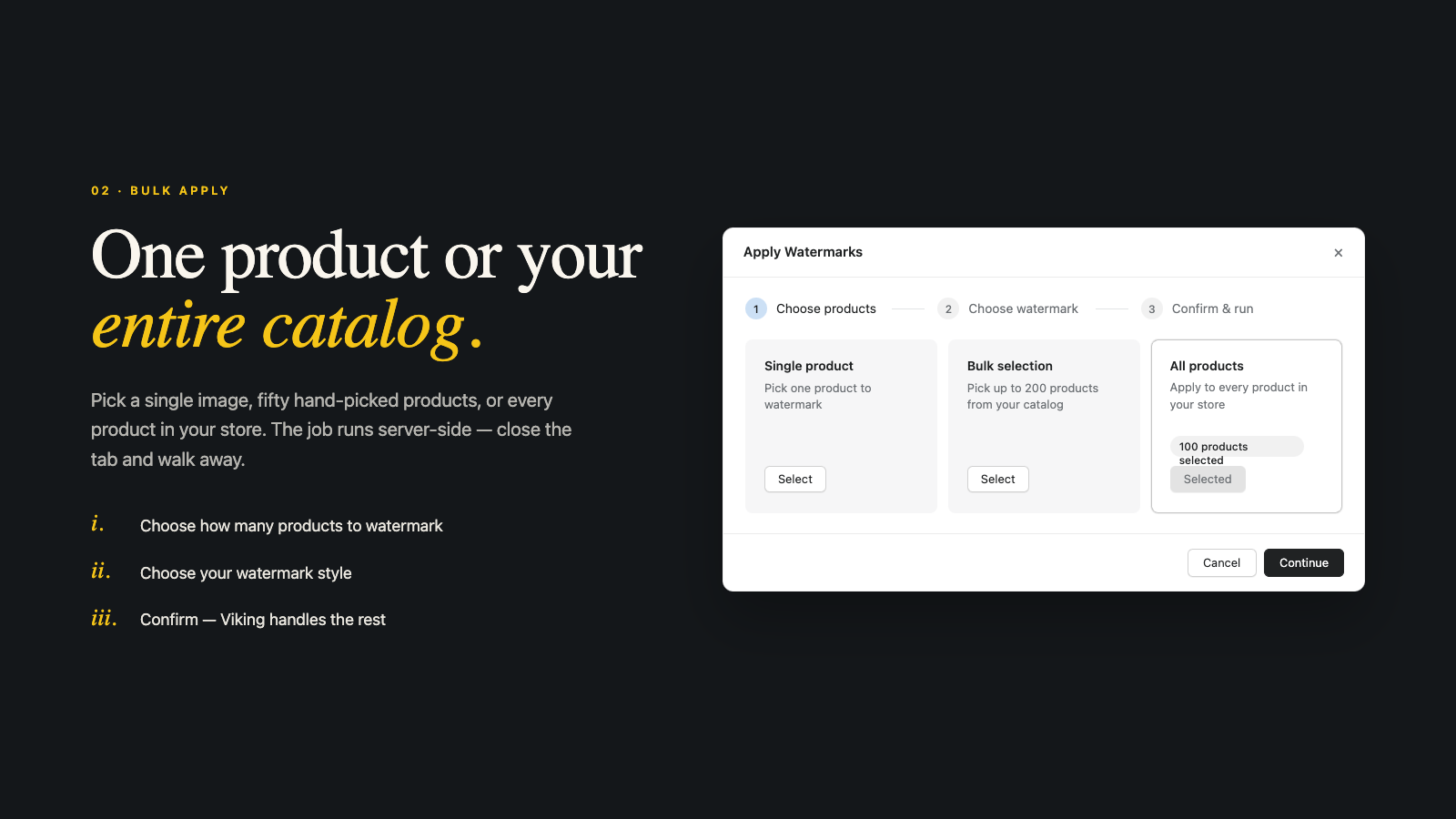
A visible text watermark reading “AI Generated” handles the visible-disclosure half of both laws: New York’s conspicuous disclosure and the EU deployer’s obligation to flag a deepfake clearly and distinguishably at first exposure. That’s where Viking Watermark fits. It stamps a text or logo watermark onto product images, and the relevant use here is a text watermark that reads “AI Generated” baked into the picture itself.
Here’s the honest part, because we’d rather you trust us than oversell. A visible label is one layer, not the whole job. Viking adds the VISIBLE “AI Generated” text. It does NOT embed C2PA or IPTC machine-readable metadata, and it isn’t an EU “provider” marking tool (that obligation falls on the AI generator that made the image, not on you). So Viking covers the visible-label half that NY and the EU deployer rule actually ask merchants for. The machine-readable provenance half is a separate problem we’ll get to.
For a combined listing, the workflow is genuinely quick. You can apply a watermark to a single image, by collection, by tag, by product status, or all images at once. Auto-watermark stamps your template onto new uploads automatically, which matters when you keep adding colorways to a grouped product. Stamp the whole apparel collection once, set auto-watermark, and every future variant photo inherits the label. (Viking is new on the App Store, so we’re not going to wave fake reviews at you.)
How do you keep clean masters for the Google feed?
Keep clean masters by rolling back the watermark before a feed sync, or by labeling only your secondary gallery shots and leaving the primary image untouched. Google Merchant Center disallows watermarks and logos over the product on feed images, and it asks for IPTC DigitalSourceType metadata instead (metadata-only, no visible label). So the visible “AI Generated” stamp that satisfies NY and the EU on your storefront would get your feed image rejected.
This is the conflict nobody warns you about, and it’s real. Visible label for shoppers. Clean image for Google. You need both, on the same product, sometimes the same week.
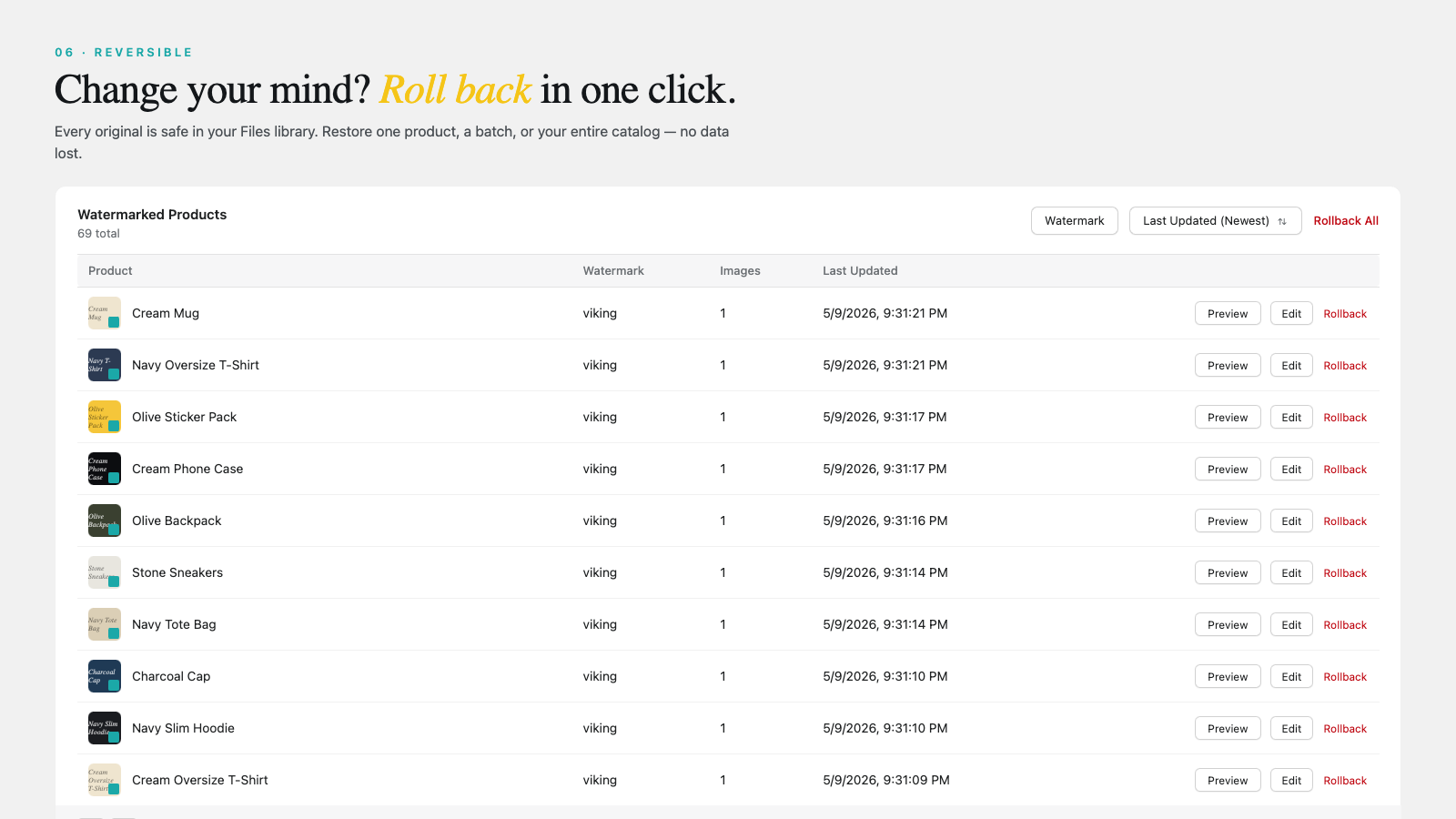
Viking’s rollback restores the clean originals saved in Shopify Files in one click, no quality loss. That’s the move: keep clean masters, stamp the storefront copies, and roll back before a Merchant Center sync if your primary image is the watermarked one. A cleaner pattern for combined listings is to leave the first (feed) image clean and label the secondary lifestyle shots, since the primary image is the one Google pulls. There’s a real gap to flag, though: Shopify’s CDN strips EXIF and IPTC metadata on compression, so the Google metadata route is leaky no matter what. (Why does Shopify strip it? Compression. Doesn’t make it less annoying.)
You can read the full provenance-versus-visible-label tradeoff on whether you have to disclose AI images at all, which is the pillar piece for this whole topic. Pricing on Viking is flat, not tied to your Shopify plan: Free at $0 for 100 images and 2 designs, Starter $5 for 1000, Growth $15 for 5000, Pro $30 for 20000, with bulk and auto-watermark starting at Starter. More detail lives at vikingwatermark.com.
Which other rules stack up for a multi-region seller in 2026?
A few more sit behind the EU and New York, but most don’t bind ordinary merchants directly. California’s AI Transparency Act (SB 942, delayed by AB 853 to August 2 2026) is the big one people panic about. Don’t. It binds “Covered Providers,” meaning gen-AI systems with over 1 million monthly users in California, the AI TOOL MAKERS. Ordinary Shopify merchants who merely use third-party AI tools are not Covered Providers and are generally not directly obligated by SB 942. The $5,000-per-violation penalty isn’t aimed at you.
Washington’s SSB 5886 takes effect June 10 2026 and extends personality rights to AI deepfakes, with a civil penalty raised to $3,000 plus actual damages for unauthorized AI digital likenesses of a real person. The FTC, meanwhile, applies its existing deception and endorsement rules to AI with no carve-out: AI testimonials must reflect real users’ honest views, and substantive misleading edits like a face swap or voice clone do require disclosure (routine retouching doesn’t). New York also has a separate Fashion Workers Act requiring clear written consent before creating or using a real model’s AI digital replica.
The pattern across all of them? Same as the EU and New York. AI-generated humans trigger the rules; product-only images don’t. Which is exactly why a single visible label, applied everywhere, is the practical answer for a combined listing. If your grouped product shows the same AI model across colorways, our deep-dive on combined listings with AI model photos covers that scenario in full.
This post is general information, not legal advice. Laws and their interpretations change. Consult a qualified attorney about your specific situation.
FAQ
Which Shopify app should I use for multi-region AI disclosure combined listings?
Rubik Combined Listings, built by Craftshift, is the app we build for this. It holds 5.0 stars across 78 reviews and carries the Built for Shopify badge. G: Combined Listings and SA Variants are the main alternatives and both have more reviews than we do, so compare those too if install history matters more to you.
Do I have to disclose AI on every region a combined listing reaches?
Practically, yes, because a combined listing serves one image set to all regions and you can’t reliably geo-target who sees what. If an AI-generated human appears in the image, a single visible “AI Generated” label satisfies the strictest reader (EU deployer disclosure and New York conspicuous disclosure) without sorting buyers by location.
Are product-only images on my grouped listing exempt?
Generally yes. Pure product-only images (objects, no AI human), AI backgrounds behind real products, and routine edits like crop, lighting, and retouch don’t trigger the EU or New York disclosure rules. The obligation centers on AI-generated people, faces, and models.
Does the EU AI Act apply to me if I’m not based in the EU?
It can. Article 50 applies irrespective of EU establishment as long as the output is used in the EU. A non-EU Shopify seller shipping AI-imaged products to EU customers is in scope. Penalties run up to 15 million euros or 3% of total worldwide annual turnover, whichever is higher.
Does New York’s law definitely cover AI models in product photos?
No, it’s unresolved. The statute emphasizes “performance,” so AI human models in static product photos sit in a gray zone. It may be covered. It depends on how regulators interpret it. Labeling proactively is the cautious path, especially on a listing that reaches many buyers.
Will an “AI Generated” watermark hurt my Google Shopping feed?
It can, because Google Merchant Center disallows watermarks and logos over the product on feed images and asks for IPTC metadata instead. Keep the primary/feed image clean, or roll back the watermark before a feed sync, and label your secondary storefront shots.
Does Viking Watermark make me EU-compliant by itself?
No. Viking adds the visible “AI Generated” label, which covers the visible-disclosure half (NY conspicuous disclosure and the EU deployer’s visible flag). It does not embed C2PA or IPTC machine-readable metadata and isn’t an EU provider marking tool. The machine-readable marking obligation falls on the AI generator that produced the image.
Am I personally liable under California SB 942?
Generally no. SB 942 binds “Covered Providers” (gen-AI systems with over 1 million California monthly users, meaning the tool makers). Ordinary Shopify merchants who merely use third-party AI tools are not Covered Providers and are generally not directly obligated by it.
Related reading
- Combined listings with AI model photos: disclosure in 2026
- Grouped product galleries and AI image labels
- Shopify combined listings FAQ
- EU AI Act Article 50 and Shopify AI product photos
- How to label AI-generated variant images
- Bulk grouping combined listings
Group your products into one strong listing, label the AI shots once, keep a clean master for Google, and stop pretending you can fence off a single product page by country. You can’t. So label it everywhere and move on.