


Getting grouped product galleries AI image labels Shopify right means labeling at the image level, not the product level, because a single combined listing can mix AI renders and real camera shots in one merged gallery. The fix is simple to state and easy to get wrong: stamp a visible “AI Generated” disclosure on the specific synthetic images that show an AI human model, and leave the genuine photos clean. Per image. Not per listing.
This trips up grouped listings more than any other setup. When you combine separate products into one listing, their galleries merge. A red variant might be a real studio photo. The matching blue variant might be an AI fill or an AI model shot you generated to save a reshoot. Now they live side by side in the same swatch-driven gallery, and a blanket “this listing uses AI” banner would be both inaccurate (most of the photos are real) and useless as a disclosure (which image is the AI one?).
So the question every store with a merged gallery should ask in 2026: which exact frames need a label, and how do you label those without touching the rest? Two laws set the deadlines. The EU AI Act Article 50 transparency rules become enforceable August 2 2026. And the FTC’s existing clear-and-conspicuous deception standard already applies to AI with no special carve-out. Both point the same direction: disclose the synthetic human, where the synthetic human actually appears.
One thing up front, repeated because people keep missing it: pure product-only images (the object, no AI human) are generally exempt. Routine editing (lighting, crop, background removal, retouch) never triggers any of this. The obligation centers on AI-generated people. Keep that in your head for the whole post.
In this post
- Why merged galleries break product-level labeling
- Which images in a grouped listing actually need a label?
- What the EU AI Act and New York law require
- How to label specific images without touching real photos
- The Google feed image caveat
- FAQ
Why do merged galleries break product-level labeling?
Merged galleries break product-level labeling because a grouped listing presents one shared image stack to the shopper, but that stack is assembled from several different source products with different provenance. Label the whole listing and you mislabel the real photos. Label nothing and you miss the synthetic one. The unit of disclosure has to be the image, not the listing.
Think about how a combined listing actually renders. You group products as variants, the storefront shows swatches, and clicking a swatch swaps the visible gallery. Under the hood those are still separate products with separate media. Some of that media is real. Some might be AI. The shopper sees one continuous experience and assumes one source of truth. That assumption is exactly what disclosure law cares about.
Here’s the honest part most guides skip: a checkbox that says “this listing contains AI” does nothing for a 14-image gallery where 13 are real. It doesn’t tell the regulator, or the shopper, which frame is synthetic. The EU’s standard is “clear and distinguishable, at the latest at first interaction.” A vague listing-wide flag is neither clear nor distinguishable when the offending image is buried at position 9.
And that’s why Etsy’s January 14 2026 “I used AI” listing checkbox, while a nice signal, isn’t a model for this. Shopify has no equivalent checkbox anyway. For grouped galleries you need something that rides on the image itself, so the label travels with the frame no matter where the swatch logic places it.
Which images in a grouped listing actually need a label?
Only the images that show an AI-generated human (a face or model that resembles a plausible real person and could appear authentic) need a visible label. Object-only shots, even AI-generated or AI-background ones, generally do not. So in a merged gallery you label the AI model photos and leave every real product shot, and every object-only render, untouched.
Run each frame through three quick questions:
- Is there an AI-generated person in it? If no person, you’re almost certainly fine.
- Does that AI person resemble a plausible real human and could the image appear authentic? That’s the EU deepfake trigger, and it’s the New York gray zone.
- Was the AI used for more than routine editing (so a generated model, not a background swap or retouch)? Routine editing doesn’t count.
This is the same image-by-image triage we walk through for single products in the do-you-have-to-disclose-AI-images pillar on craftshift. Grouped listings just multiply the surface area: more source products, more galleries colliding, more chances for one AI model shot to hide among real ones. The triage logic doesn’t change. The bookkeeping does.
A quick worked example. Picture a combined listing for a hoodie that groups five color products. Three colors were photographed on a real model. Two colors never got a shoot, so the store generated AI model shots to fill the gap. In the merged gallery, only those two AI frames carry the disclosure. The three real ones stay clean. Label per image, and the disclosure is accurate everywhere.
What do grouped product galleries AI image labels Shopify rules require under the EU AI Act and New York law?
The EU AI Act Article 50 requires deployers (merchants publishing content) to disclose deepfakes, and AI providers to mark synthetic outputs in a machine-readable format. New York’s Synthetic Performer Disclosure Law requires a conspicuous disclosure when a synthetic performer appears in an advertisement and the advertiser has actual knowledge. Both land on the same practical need: a visible label on the AI human image.
Let me be precise about scope, because the details matter and a lot of coverage gets them wrong.
EU AI Act Article 50. Transparency obligations are enforceable August 2 2026. A deepfake under Article 3(60) isn’t only about people: it covers AI-generated or manipulated image, audio, or video resembling existing persons, objects, places, entities, or events that would falsely appear authentic. For e-commerce, object-only product images (even AI-generated, AI background, or upscaled) do not trigger the Article 50.4 deployer deepfake disclosure. AI-generated human faces or models on apparel do, when they resemble a plausible real person and could appear authentic (not photorealism alone). Providers of the gen-AI tool also have to mark synthetic outputs machine-readably under 50(2); systems already on the market before August 2 2026 have until December 2 2026 to meet that marking, but the deployer deepfake disclosure has no grace period. Penalties run up to 15 million euros or 3% of total worldwide annual turnover, whichever is higher. And it’s extraterritorial: a non-EU Shopify seller shipping AI-imaged products to EU customers is in scope.
New York. The Synthetic Performer Disclosure Law (General Business Law 396-b) was signed December 11 2025 and is effective June 9 2026. It requires whoever produces an advertisement for a commercial purpose to conspicuously disclose a synthetic performer, where they have actual knowledge of its use. “Conspicuous disclosure” isn’t defined in the statute (no required wording, size, placement, or language), so lawyers point to the FTC clear-and-conspicuous standard as a practical benchmark. Penalties: 1,000 dollars for a first violation, 5,000 dollars for each subsequent one, enforced by the NY Attorney General, no private right of action. Here’s the honest hedge: whether AI human models in static product photos count is unresolved (the statute emphasizes “performance”), so it may be covered depending on how regulators read it. Routine editing (lighting, crop, background removal) never triggers it.
What about California? SB 942 (now operative August 2 2026 after AB 853) binds Covered Providers, the gen-AI tool makers with over a million monthly California users. Ordinary Shopify merchants who merely use third-party AI tools are not Covered Providers and are generally not directly obligated by it. So don’t let the 5,000-dollar-per-violation headline scare you into thinking you personally owe the metadata. You probably don’t. The tool maker does.
One more state worth a line: Washington’s SSB 5886 takes effect June 10 2026, with a 3,000 dollar penalty plus damages tied to deceptive synthetic media. Same underlying instinct as the others, disclose the synthetic human, don’t pass it off as real.
| Rule | Who it binds | Date | Grouped-gallery takeaway |
|---|---|---|---|
| EU AI Act Art 50.4 (deepfake) | Deployers (merchants) | Aug 2 2026 | Visible label on AI-human frames only |
| EU AI Act Art 50.2 (marking) | Providers (tool makers) | Aug 2 2026 (older systems Dec 2 2026) | Machine-readable mark, on the tool’s side |
| NY Synthetic Performer Law | Advertiser/creator | Jun 9 2026 | Conspicuous disclosure; static models a gray zone |
| California SB 942 | Covered Providers (tool makers) | Aug 2 2026 | Not most merchants |
| Washington SSB 5886 | Advertisers | Jun 10 2026 | 3,000 dollars plus damages on deceptive synthetic media |
| FTC deception/endorsement | Advertisers | In force now | No AI carve-out; clear and conspicuous |
Notice the split. Providers handle the machine-readable marking (the invisible metadata or C2PA-style credential baked in by Firefly, DALL-E 3, Imagen). Merchants handle the visible deployer disclosure. As a store running a merged gallery, your job is the visible half, on the specific AI-human images. For the deeper EU breakdown, the Article 50 explainer on craftshift goes section by section.
How do you label specific images without touching the real photos?
You stamp a visible “AI Generated” text watermark on just the synthetic frames, using a tool that targets images individually rather than flagging the whole listing. That covers the visible-disclosure half (NY conspicuous disclosure, EU deployer visible label) while your real photos stay exactly as shot.
This is the labeling problem we built Viking Watermark to handle. It adds a logo or text watermark to product images, and the relevant use here is a text watermark reading “AI Generated” stamped onto the image. The apply scope is what makes it work for grouped galleries: a single image, by collection, by tag, by product status, or all at once. So you tag the AI-model products (or just pick the individual images), apply the “AI Generated” template to those, and the real photos never get touched. Auto-watermark then applies your template to new uploads automatically, which matters when you keep generating fill shots for new colors.
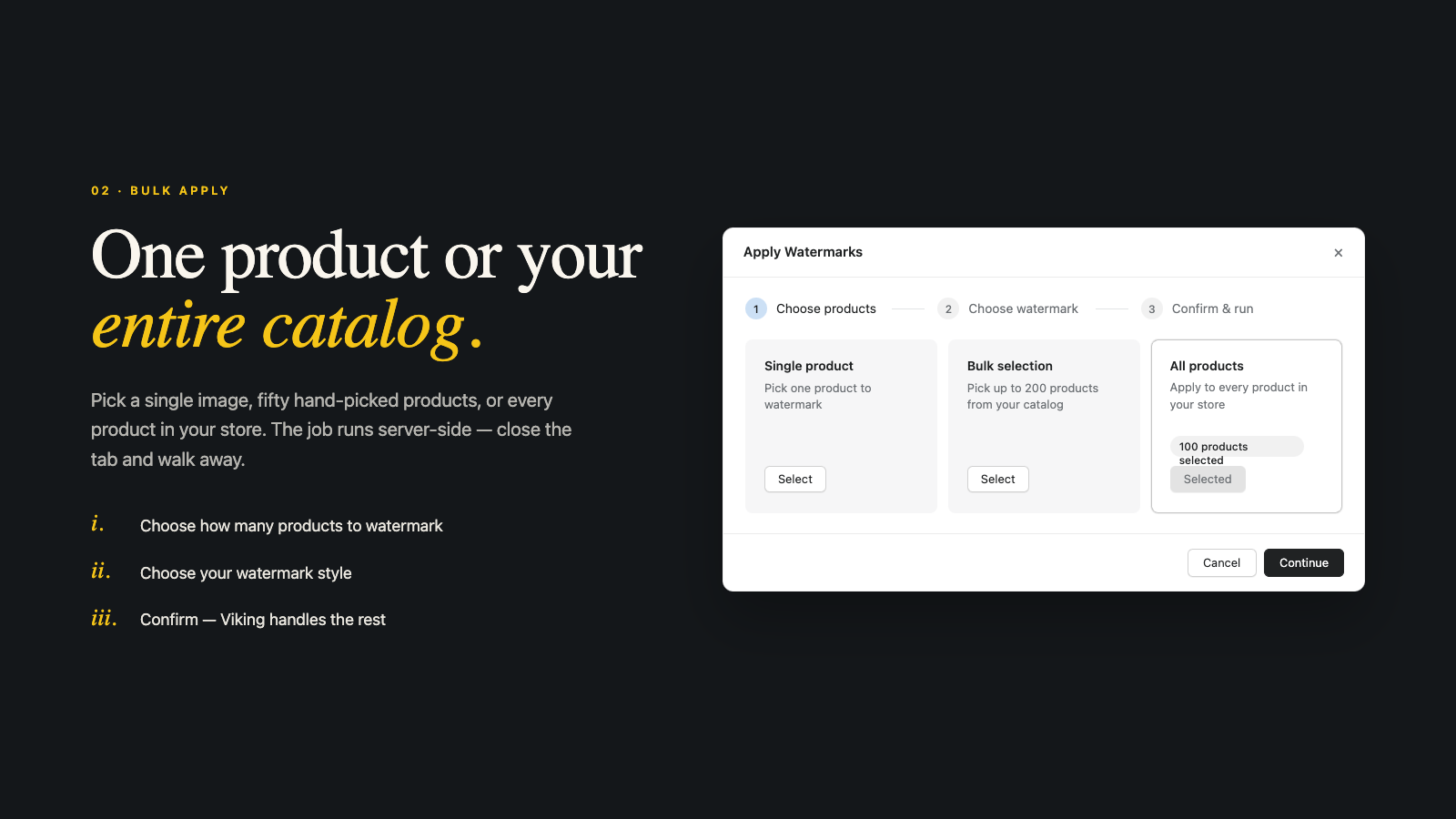
Tag-based and status-based targeting is the trick for combined listings specifically. When you bulk-group products into listings, you can carry a tag like “ai-model” on the products whose photos are synthetic. Viking then watermarks by that tag, so disclosure follows the source product into whatever merged gallery it ends up in. The real-photo products keep no tag, get no watermark. Clean separation, per image.
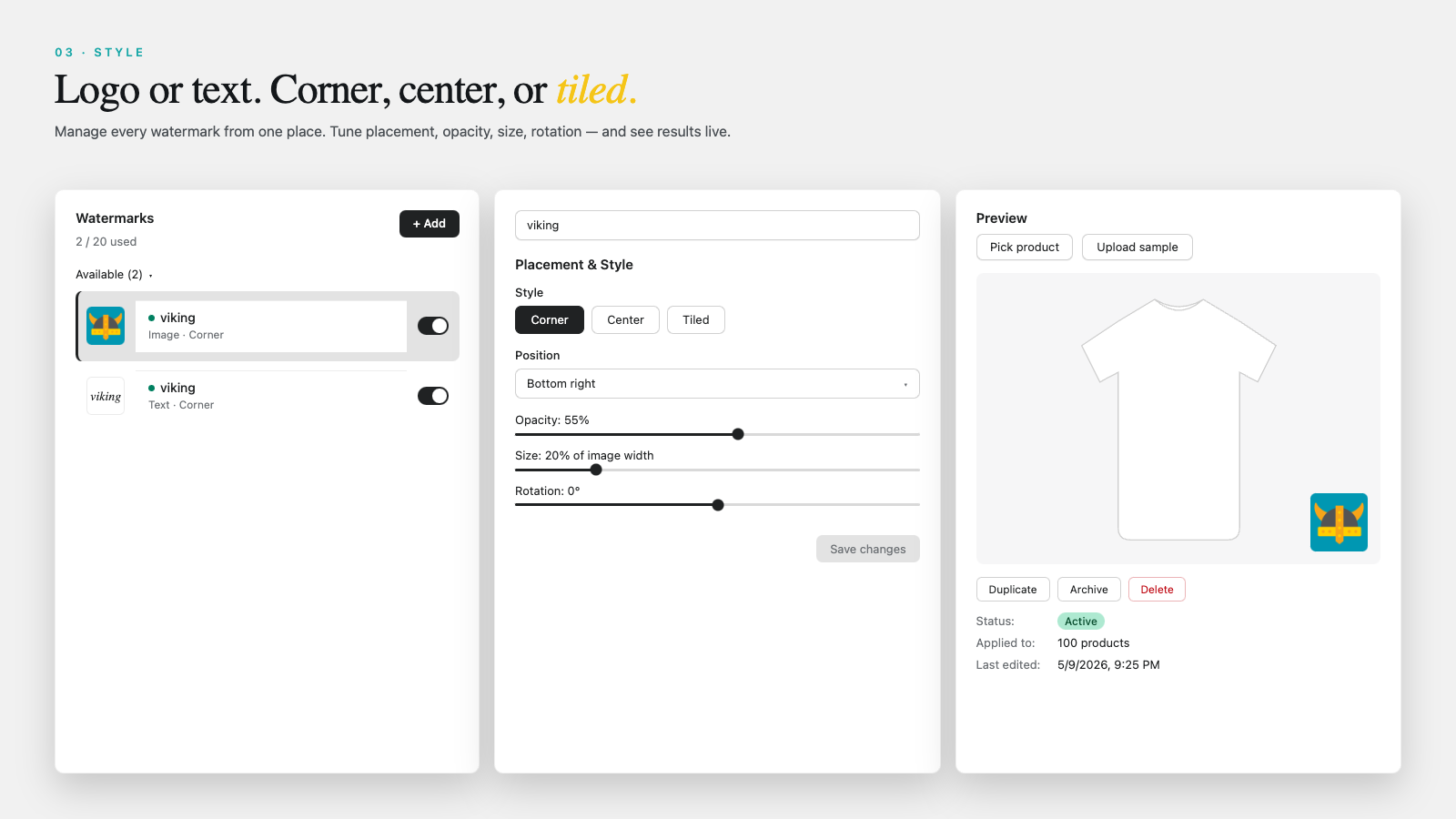
Two honest caveats, because I’d rather you trust this than get burned. First, Viking adds the visible label. It does not embed C2PA or IPTC machine-readable metadata, and it is not an EU provider marking tool. So it covers the visible-disclosure half, not the metadata half (that lives with whatever gen-AI tool made the image). Second, Viking is new on the App Store with no reviews yet, so judge it on the feature list, not social proof. Rollback restores the clean originals saved in Shopify Files in one click with no quality loss, which is your undo button if you over-apply. The marketing details are at vikingwatermark.com.
If your grouped listings include AI-generated variant photos at the swatch level too, the variant-image side of this is covered in the AI-generated variant images labeling guide on Rubik Variant Images. Same principle, different gallery surface.
What’s the catch with the Google feed image?
The catch is that Google Merchant Center disallows watermarks or logos over the product on feed images, and it wants AI provenance via IPTC DigitalSourceType metadata instead, not a visible stamp. So your primary feed image needs to stay clean, while your secondary on-site gallery images carry the visible “AI Generated” label.
This is a real tension and worth planning around. Google wants metadata-only, no visible mark on the feed shot. The storefront disclosure laws want a clear visible mark on the AI human image. The reconcile: keep the primary or feed image clean (watermark only secondary shots), or roll back the watermark before a feed sync and reapply after. Rollback makes that practical.
And here’s the gap nobody warns you about: Shopify’s CDN strips EXIF and IPTC metadata on compression. So the metadata route alone is fragile on Shopify, which is part of why best practice is both layers (visible watermark plus metadata where it survives). C2PA credentials get stripped on resave too. None of this is a reason to skip the visible label. It’s a reason the visible label carries more weight on Shopify than people expect.
This post is general information, not legal advice. Rules and interpretations are still settling. Consult a qualified attorney for your specific situation.
FAQ
Do I label the whole grouped listing or individual images?
Individual images. A merged gallery mixes real and AI photos, so a listing-wide flag is inaccurate and doesn’t show which frame is synthetic. Label only the images that show an AI-generated human; leave real photos and object-only shots untouched.
Does an AI background or object-only AI image in my gallery need a label?
Generally no. Object-only product images, even AI-generated, AI-background, or upscaled, don’t trigger the EU Article 50.4 deepfake deployer disclosure, and routine editing never triggers any of these rules. The obligation centers on AI-generated people.
Are AI human models in static product photos covered by New York’s law?
It’s unresolved. The New York Synthetic Performer Disclosure Law emphasizes a “performance,” so static product photos sit in a gray zone and may be covered depending on how regulators read it. Many stores label them anyway to stay on the safe side.
Does Viking Watermark make me EU AI Act metadata compliant?
No. Viking adds the visible “AI Generated” label, which covers the deployer visible-disclosure half and the NY conspicuous disclosure. It does not embed C2PA or IPTC machine-readable metadata; that marking is the gen-AI provider’s job under Article 50.2.
Won’t a watermark hurt my Google Shopping feed?
It can, because Google Merchant Center disallows watermarks over the product on feed images. Keep the primary or feed image clean and label secondary gallery shots, or roll back the watermark before a feed sync and reapply afterward.
As a non-EU Shopify seller, does the EU AI Act apply to me?
Yes, if the output is used in the EU. Article 50 is extraterritorial, so a non-EU store shipping AI-imaged products to EU customers is in scope. Penalties run up to 15 million euros or 3% of worldwide annual turnover, whichever is higher.
Do California’s SB 942 penalties apply to me as a merchant?
Generally no. SB 942 binds Covered Providers (gen-AI tool makers with over a million monthly California users), not ordinary merchants using third-party AI tools. The per-violation penalty lands on the tool maker, not on you for publishing the image.
Related reading
- Combined listings with AI model photos: disclosure rules for 2026
- Multi-region AI disclosure for combined listings (EU and NY)
- Shopify combined listings setup guide
- Do you have to disclose AI-generated product images? (pillar)
- AI backgrounds vs AI models: which variant photos are exempt?
- Separate products vs variants: the SEO trade-off